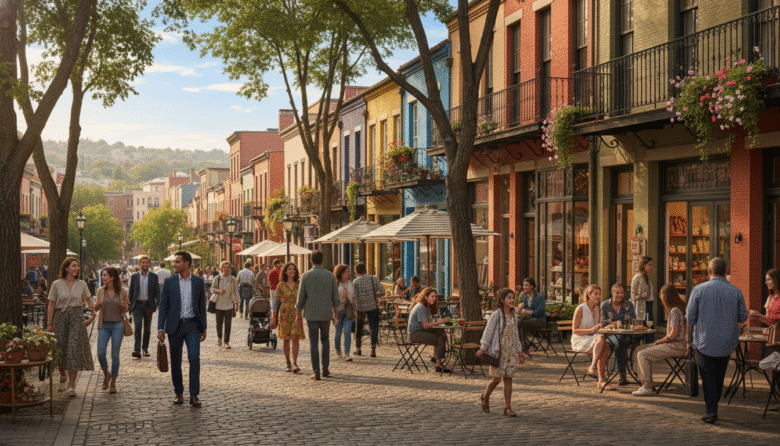
When you look for a new home, the rent price often gets the most attention. But focusing only on that number can be a big mistake. The true cost of your life includes many other monthly expenses.
Living in a place where you can walk to shops, work, and parks changes your budget. A recent National Association of Realtors survey found that 79% of people say walkability is important. Many also report being very satisfied with their life in these communities.
This high satisfaction comes from real savings. People in these urban areas often spend much less on their car. This means no car payment, lower insurance, and no gas costs. You can say goodbye to parking fees and expensive repairs.
This article will explore how a pedestrian-friendly lifestyle leads to a lower total cost of living. We will look at the financial benefits and the improved quality of life. You will learn how to find the right community for a car-light life.
Key Takeaways
- Total monthly living costs involve more than just your rent payment.
- Walkable urban areas can significantly reduce or eliminate car-related expenses.
- Most people value walkability and report higher life satisfaction in such communities.
- The overall cost of living can be lower even if rent prices appear higher at first glance.
- Transitioning to a car-light lifestyle offers both financial and personal well-being benefits.
Understanding the Financial Benefits of Walkable Living
The true measure of affordability involves more than just your rent check. Many expenses add up throughout the month. These costs can dramatically change your budget.
Lower Transportation and Car-Related Expenses
Eliminating a car represents the biggest financial win. American households spend thousands yearly on vehicle costs. Insurance, maintenance, and fuel expenses disappear when you can walk everywhere.
Many walkable cities offer excellent public transit options. Monthly passes cost far less than car payments. This gives residents affordable alternatives for longer trips.
Impact on Utility and Lifestyle Costs
Homes in pedestrian-friendly areas tend to be more efficient. Smaller units mean lower heating and cooling bills. Electricity usage often drops compared to suburban living.
Daily walk routines replace gym memberships. Active lifestyles can lead to better health and lower medical costs. Intentional shopping reduces impulse spending common with car-based trips.
While rent price may seem higher in some urban cities, the overall budget balances favorably. Easy access to local services supports smarter spending habits. Your money goes further in well-designed walkable cities.
Exploring Urban Appeal Beyond Rental Prices
Focusing solely on rent obscures the comprehensive benefits that pedestrian-friendly environments provide residents. Survey data reveals most people report higher life satisfaction in these communities.
Quality of Life Improvements
Daily walking routines foster stronger community bonds. People naturally connect with neighbors during errands. This creates a genuine sense of belonging.
Health benefits are significant. Regular walking improves cardiovascular fitness and mental well-being. Active lifestyles reduce stress without gym memberships.
Easy access to parks and green spaces enhances mental health. Residents enjoy outdoor relaxation without transportation barriers. Cultural venues become part of daily life.
Diverse food options flourish in walkable places. Local restaurants and markets support healthier eating habits. Fresh ingredients are readily available.
| Quality of Life Factor | Pedestrian-Friendly Areas | Car-Dependent Areas |
|---|---|---|
| Social Interactions | High frequency, organic encounters | Limited, planned meetings |
| Physical Activity | Integrated into daily routine | Requires dedicated exercise time |
| Cultural Access | Immediate, spontaneous visits | Planned trips with transportation |
| Food Variety | Diverse local options within reach | Limited to shopping centers |
The city experience transforms when daily needs are within walking distance. While some pay premium prices, many affordable options exist nationwide. This makes enhanced walkability accessible to various income levels.
Choosing Cities for Walkable Living
Successful urban living depends heavily on the physical layout and amenities available within your immediate surroundings. The right combination of design elements creates environments where daily needs are easily met.
Key Characteristics of Walkable Neighborhoods
Mixed-use development forms the foundation of pedestrian-friendly areas. Residential buildings sit alongside commercial spaces and recreational facilities. This arrangement lets residents handle errands on foot.
Proper infrastructure ensures safety and comfort for everyone. Well-maintained sidewalks, adequate lighting, and traffic calming measures create inviting streets. These features make walking practical for people of all ages.
Sufficient density supports vibrant local economies. A critical mass of residents sustains diverse businesses like restaurants and coffee shops. Historic downtown areas often exemplify these ideal conditions.
Benefits from Local Businesses and Public Transit
Local establishments thrive when people can walk to them. Foot traffic supports shops and services that define community character. This creates economic vitality throughout the neighborhood.
Robust public transit extends accessibility beyond walking distance. Residents reach employment centers and entertainment districts without cars. Bike infrastructure provides another efficient option for longer trips.
When evaluating different neighborhoods, consider how these elements work together. Some areas offer complete pedestrian accessibility while others remain car-dependent. The best walkable neighborhoods integrate all these features seamlessly.
Top Walkable Cities in the United States
Walk Score rankings provide valuable insights into pedestrian-friendly urban environments across America. These measurements help identify metropolitan areas where residents can thrive without car dependency.
Highlights from San Francisco, New York, and Chicago
San Francisco leads the nation with a Walk Score of 88.7. The city’s famous Victorian architecture and diverse neighborhoods create an ideal setting for pedestrians. Iconic landmarks like the Golden Gate Bridge enhance the walking experience.
New York City follows closely with a score of 88.0. The extensive subway system supports car-free lifestyles throughout Manhattan and Brooklyn. This dense urban fabric makes walking the most practical transportation choice.
Chicago earns recognition with a Walk Score of 77.2. Neighborhoods around The Loop and Museum Campus offer excellent pedestrian access. The city’s riverwalk and lakefront paths provide scenic routes for daily errands.
Data Insights from Walk Score Rankings
The Walk Score methodology analyzes walking routes to nearby amenities. These include grocery stores, schools, parks, and restaurants. The system quantifies neighborhood walkability objectively.
Scores above 70 indicate “Very Walkable” environments where most errands can be accomplished on foot. Locations scoring above 90 represent “Walker’s Paradise” where daily needs don’t require a car.
Geographic diversity appears among top-ranked urban centers. Long Beach demonstrates that walkable environments exist beyond major metropolitan areas. This California city combines urban amenities with small-town charm.
Neighborhoods That Make a Difference
Not all urban areas offer the same level of walking convenience. Some neighborhoods excel at pedestrian accessibility through thoughtful design.
Vibrant Downtown and Historic Areas
Downtown districts serve as commercial and cultural hubs. They concentrate restaurants, shops, and employment opportunities. Residents can accomplish daily activities on foot.
Walker paradise neighborhoods like Minneapolis’s Lyn Lake achieve top walkability ratings. Car ownership becomes optional in these places. The design supports complete pedestrian independence.
Historic neighborhoods developed before automobiles dominate. Charleston’s King Street area features compact, human-scale design. This architecture naturally promotes walking.
Traditional street patterns prioritize pedestrians. Short block lengths and wide sidewalks create comfortable routes. Street-level retail and outdoor dining enhance the experience.
| Neighborhood Type | Key Features | Walk Score Range | Car Dependency |
|---|---|---|---|
| Downtown Core | Mixed-use development, transit access | 90-100 | Optional |
| Historic District | Preserved architecture, compact layout | 85-95 | Low |
| Urban Village | Local businesses, community spaces | 80-90 | Moderate |
These neighborhoods like Baltimore’s Little Italy demonstrate successful preservation. Their history and distinctive architecture create unique environments. Every walker enjoys exploring these vibrant neighborhoods.
The diversity of walker paradise options spans many regions. From Buffalo’s business district to Philadelphia’s center, highly accessible neighborhoods exist at various price points.
Comparing Monthly Expenses in Walkable vs. Car-Dependent Cities
Many people assume that pedestrian-friendly communities come with premium housing costs, but data reveals a different reality. A comprehensive analysis of urban areas shows numerous options where affordability meets accessibility.
Rent and Living Costs Analysis
All ten metropolitan areas on the affordability list feature median rents below the national average of $1,495. These locations maintain high pedestrian scores while offering reasonable housing expenses.
St. Louis stands out as the most budget-friendly option. Residents enjoy vibrant neighborhoods like Downtown and Soulard with some of the lowest housing costs nationwide. The city demonstrates that walkability doesn’t require premium price tags.
New York locations like Rochester and Buffalo prove regional diversity. Both offer median rents under $1,000 for one-bedroom apartments. This challenges the assumption that coastal markets dominate pedestrian-friendly options.
The analysis spans multiple regions including Midwest, Northeast, and Northwest areas. Each provides robust public transit and bike infrastructure that reduces transportation costs. These savings often offset any rent differences compared to car-dependent communities.
Philadelphia ranks #8 for walkability while remaining more affordable than coastal alternatives. Milwaukee places #15 for pedestrian access and #31 for affordability among 100 analyzed urban centers. The data clearly shows that numerous American metropolitan areas successfully combine these desirable features.
Insights from Real-World Data and Rankings
Walk Score rankings offer a scientific approach to evaluating neighborhood walkability across North America. The system analyzes more than 2,800 urban centers and 10,000 communities in the United States and Canada.
This comprehensive database provides objective measurements for virtually any address. The average Walk Score for America’s 130 largest metropolitan areas is just 48. Top-performing locations significantly exceed this baseline.
The methodology calculates walking routes to nearby amenities and services. This creates quantifiable metrics that help people compare different areas objectively. Instead of relying on impressions, users get reliable data.
International comparisons show Vancouver leads Canada with a score of 79.8. Montréal follows at 65.4 and Toronto at 61.0. These numbers demonstrate how walkability varies across the country.
| Metric Type | Measurement Focus | Score Range | Practical Application |
|---|---|---|---|
| Walk Score | Walking routes to amenities | 0-100 | Daily errand convenience |
| Transit Score | Public transportation access | 0-100 | Longer trip alternatives |
| Bike Score | Cycling infrastructure quality | 0-100 | Active transportation options |
Companion metrics include Transit Score and Bike Score. These tools allow comprehensive assessment of car-free living potential. The philosophy connects walkable neighborhoods to happier, healthier lifestyles.
National Association of Realtors survey data supports this connection. These rankings empower consumers to make informed decisions. Specific address-level information ensures accurate evaluations.
Local Culture, Architecture, and Community Perks
The character of a neighborhood is defined by more than its buildings. It’s shaped by the daily life and accessible amenities that create a unique sense of place.
These elements transform simple errands into enriching experiences. They foster a strong community connection that is often missing in car-dependent areas.
The Role of Local Shops, Restaurants, and Parks
Vibrant local shops and diverse restaurants are the heart of a community. In Washington DC, you can find Ethiopian food in Georgetown. Santa Fe offers unique adobe buildings and Japanese spas.
These establishments become daily destinations. They support a thriving local economy and create gathering spots for residents.
Green parks provide essential breathing room within urban settings. Savannah features 22 charming squares in its compact downtown. Chicago’s Millennium Park offers art and gardens for relaxation.
These spaces encourage outdoor activity and social interaction. They are perfect for a leisurely stroll or a weekend picnic.
| City Example | Architectural & Historical Feature | Cultural & Recreational Amenity |
|---|---|---|
| Charleston, SC | Historic homes and preserved residences | Walking tours exploring local history |
| San Francisco, CA | Iconic Victorian architecture | Scenic routes like Lombard Street |
| Old San Juan, PR | Centuries-old military and religious structures | A rich history feeling like another world |
| Chicago, IL | Modern and historic skyscrapers | Museum Campus and River Walk dining |
The blend of architecture, culture, and local shops creates an environment where walking is a pleasure. This combination strengthens community bonds and enhances daily life for everyone on foot.
Planning Your Move to a Walkable City
A successful transition to a pedestrian-focused lifestyle begins with a well-planned scouting trip. Visiting your target urban area lets you experience daily life firsthand.
Use public transit and travel by foot just like a resident would. This tests if the environment matches your personal preferences.
Travel Tips and Neighborhood Scouting
Research transportation options before you arrive. In Washington DC, the metro system provides easy access from the airport.
Waikiki’s public bus system allows exploration without a rental car. Be aware that some places like San Luis Obispo have expensive ride-share services.
Stay in centrally located accommodations to maximize your walking experience. Create a list of essential amenities like grocery stores and healthcare facilities.
Evaluate which neighborhoods provide convenient access to them. Walkability can vary greatly between different districts in the same city.
Budgeting for a New Lifestyle
Calculate potential savings from reducing car expenses. Compare rent prices across various neighborhoods within your target urban area.
Factor in the costs of monthly transit passes or bike-sharing memberships. These are key for a car-light life.
| Scouting Activity | Key Evaluation Metric | Goal |
|---|---|---|
| Timing Walks | Distance to key destinations | Practical daily routine |
| Sidewalk Assessment | Condition and safety | Comfort and accessibility |
| Observing Foot Traffic | Neighborhood vibrancy | Community engagement level |
Exploring multiple walkable neighborhoods ensures you find the perfect fit. This careful planning leads to a smooth and financially sound move to your new city.
Conclusion
The financial advantages of pedestrian-friendly urban environments extend far beyond what appears on a rental agreement. Eliminating car expenses creates substantial monthly savings that often offset any premium housing costs.
Quality of life improvements are equally significant. Regular walking enhances health while stronger community connections enrich daily experiences. These benefits span from San Francisco to Long Beach and across the country.
Diverse options exist at various price points. Affordable walkable cities like St. Louis demonstrate accessibility for different income levels. Each neighborhood offers unique character through local shops and public transit access.
Evaluating potential home locations requires considering multiple factors beyond just Walk Score numbers. Bike infrastructure and community amenities contribute to successful urban experiences.
The growing availability of pedestrian-oriented development makes this lifestyle increasingly practical. People nationwide are discovering that well-designed urban centers support both financial wellness and personal fulfillment.